


In this article, we will review the process of Calculating value added tax in detail using Al-Badr Sales Pro, ensuring compliance for our software users across all Arab nations.
What is Value Added Tax (VAT)?
Value Added Tax is a type of indirect tax imposed on consumers when purchasing or selling goods and services through businesses. Defined by legislation as a specific percentage of the final product or service value, it is implemented at every stage of the supply chain, from initial manufacturing down to the final point of sale, where it is directly appended to the invoice total.
Applied in over 160 countries globally, this tax has become a foundational revenue stream for governments. Germany and France were among the pioneering nations to implement this taxation model during World War I. Value Added Tax differs fundamentally from income tax because it targets consumption rather than earnings, applying uniformly to all transactions regardless of an individual’s personal income bracket.
The Importance of Value Added Tax
As an indirect consumption tax levied on the incremental value of goods and services at each production and distribution milestone, Calculating value added tax serves as an indispensable source of state revenue globally. It provides multiple structural benefits, including:
- Expanding Government Revenue Streams: The process of Calculating value added tax acts as a primary fiscal channel to fund essential public utilities, including healthcare infrastructure, national education systems, and civil projects.
- Reducing Reliance on Direct Taxes: It diversifies state income away from traditional direct channels like personal or corporate income tax, distributing the fiscal contribution more evenly across consumer activities.
- Promoting Equitable Contribution: Because the final cost settles on the ultimate consumer proportionally based on spending habits, it functions as a balanced system that applies uniformly across transactions.
- Stimulating Smart Economic Production: The framework rewards efficient operations and manufacturing models, injecting agility into local commercial ecosystems and driving domestic economic growth.
- Encouraging National Savings and Investment: By implementing a tax centered on consumption, the system naturally incentivizes capital retention and business reinvestment among different social brackets.
- Enhancing Corporate and Commercial Transparency: The strict requirement for formal invoicing and precise transaction logging builds an auditable commercial environment and drastically elevates compliance rates.
Calculating Value Added Tax: Appending Tax to the Base Price
This process refers to determining the final retail price of a product or service after appending the required tax percentage. It involves calculating the specific percentage rate of the asset’s original value and adding that amount to the net cost.
Example: If the base price of an item is $100 and the tax rate is 10%, the final gross price after Calculating value added tax will be $110.
Calculating Value Added Tax: Extracting Tax from the Gross Price
This calculation involves determining the original net price of a product or service before any tax was applied. In this scenario, we reverse-engineer the gross invoice total to isolate the underlying price paid by the customer prior to tax application.
Example: If the final gross price including tax is $110 and the tax rate is 10%, the original base price before Calculating value added tax will be $100.
The Methodology of Value Added Tax Execution
Calculating value added tax applies to standard commodities and services within various regional markets, such as Egypt, the Kingdom of Saudi Arabia, and the United Arab Emirates. However, because not all commercial entities or product classifications are legally subject to this obligation, you must verify your specific corporate tax liabilities.
An introductory video from the Zakat and Income Authority about the Value Added Tax (VAT) account
Compliance Steps for Tax Implementation in the Kingdom of Saudi Arabia
The following steps explain the method for Calculating Value Added Tax (VAT) specifically for businesses operating in Egypt and the Kingdom of Saudi Arabia:
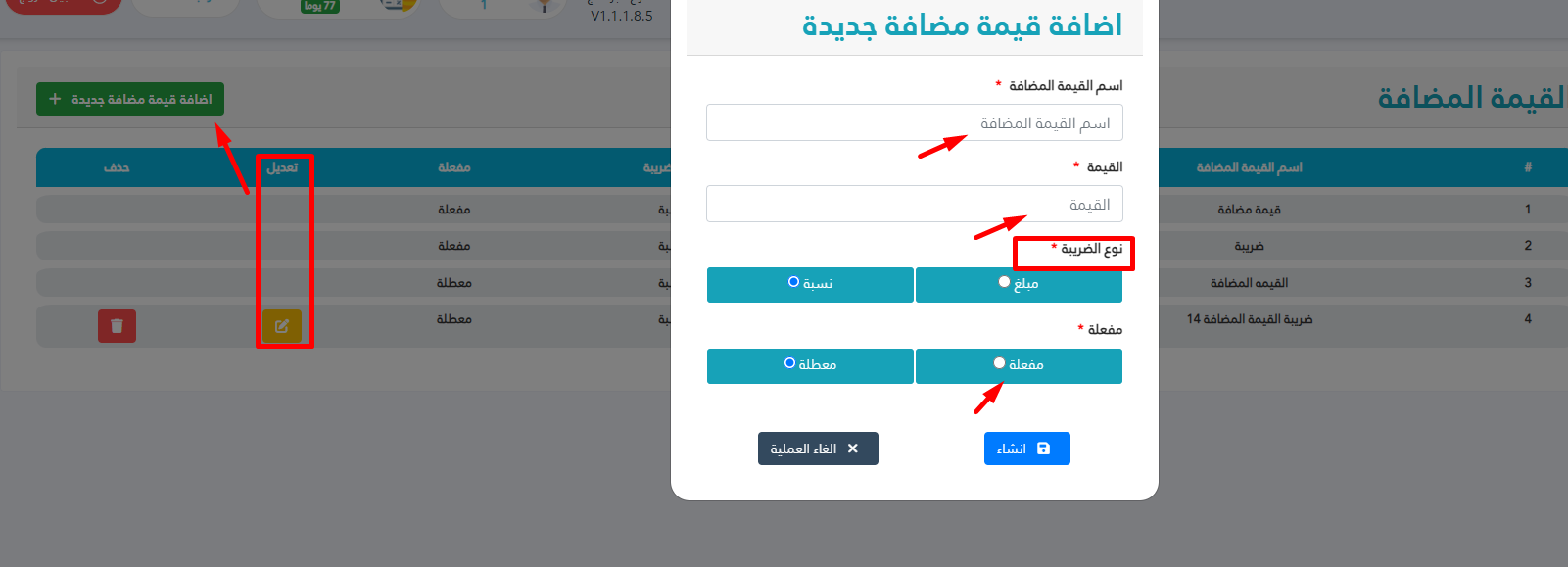
Access the main system menu, select Settings, and click Value Added Tax.

After accessing this screen, you can modify existing tax rates or add a new VAT value by entering the tax title, percentage rate, tax classification type, and toggling activation as shown.
Three Scenarios for Recording Item Invoices
When recording item invoices, Calculating Value Added Tax (VAT) follows one of three explicit possibilities:
1- Tax-Exempt Items
In this case, the item price remains equal to its defined retail selling price without adding tax. For example, if an item costs 100 SAR and is tax-exempt, the VAT entry field underneath remains empty without adding additional amounts, keeping the final price at 100 SAR.
2- Tax-Inclusive Pricing
Here, the 100 SAR selling price already includes Value Added Tax. Below the item entry, the system provides a clear breakdown displaying the original base product cost plus the embedded VAT portion, summing them together to form the tax-inclusive retail total (86.96 + 13.04 = 100 SAR).
3- Tax-Exclusive Pricing
In this scenario, the 100 SAR price does not include Value Added Tax. Upon selecting the item during invoice creation, Al-Badr Sales Pro executes Calculating Value Added Tax (VAT) by adding an extra tax amount onto the base cost, producing the final payable sum (100 + 15 = 115 SAR).
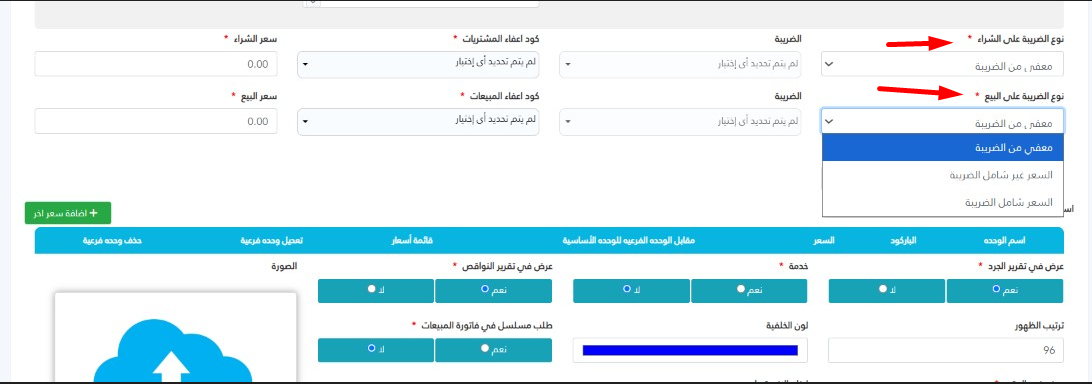
Al-Badr Sales Pro processes tax-exempt, tax-inclusive, and tax-exclusive items effortlessly, even when combined within a single transaction invoice. To configure these settings, navigate to the Items menu and click Add New Item as shown.

At the bottom of the item creation form, you will find options under Purchase and Sales Tax Type to select Tax-Exempt, Price Exclusive of Tax, or Price Inclusive of Tax as shown.
Value Added Tax (VAT) Features in Al-Badr Sales Pro
- When enabling invoice add-ons and automated tax settings, a dedicated Tax Calculation field displays on sales and purchase invoices, Calculating Value Added Tax (VAT) directly on sales and purchases while separating tax amounts from gross base totals.
- Built-in reporting modules calculate output VAT on sales, input VAT on purchases, and tax variance differences to simplify determining net tax liabilities through the software. Within the invoices menu, the VAT Calculation Report displays tax breakdowns over specified timeframes, detailing sales VAT, purchase VAT, and net tax variance.
Furthermore, calculated tax totals display on printed customer receipts. You can access receipt customization options by navigating to Settings in the side menu, clicking Settings, and selecting Invoice Printing Settings as shown.

Next, choose your invoice template format: Cashier Receipt or Full Invoice. Clicking Full Invoice opens the template settings.


Clicking Full Invoice displays the complete invoice layout as follows:

Core Ecosystem Modules of Al-Badr Sales Pro
- Point of Sale (POS) Terminal Interface
- Advanced Warehouse and Inventory Control
- Restaurant Cashier Management System
- Mobile Sales Representative Application
- F&B Accounting and Hospitality Modules
- Small Business Enterprise Accounting Suites
- Egyptian Electronic Invoicing Integration
- Saudi ZATCA Phase II Electronic Invoicing Suite
FAQ About Calculating Value Added Tax
What is the underlying mechanism of Value Added Tax (VAT)?
Value Added Tax is an indirect tax applied to commodities and services worldwide, appended directly to the base price at the point of sale. In regions like Saudi Arabia, corporate registration is mandatory once an enterprise crosses specific annual revenue thresholds.
What is the fastest method for Calculating value added tax?
To determine your tax amount, multiply the net value of your product or service by the active tax rate (which stands at 15% in Saudi Arabia). For example, a 100 SAR product multiplied by a 15% rate yields a 15 SAR tax value, resulting in a 115 SAR total.
Are all business enterprises legally required to process VAT?
No. The requirement applies specifically to firms whose annual taxable revenue meets or exceeds the regulatory minimums set by authorities like the Zakat, Tax, and Customs Authority (ZATCA). Qualifying companies must register and issue compliant tax invoices.
How do businesses file their periodic VAT returns?
Registered businesses must file tax returns either quarterly or monthly, depending on their annual revenue scale. Filings are submitted through official tax portals, detailing all gross sales, eligible business procurement inputs, and calculated tax balances.
What distinguishes Value Added Tax from standard Income Tax?
Value Added Tax is an indirect tax tied specifically to consumption and transaction velocity at the point of purchase. Income tax is a direct tax levied on the net annual profits and earnings generated by corporations or individuals.
Can a registered business claim back input tax credits?
Yes. If your business purchases goods or services from tax-registered suppliers, you can reclaim that input tax. This credit is offset against the tax collected on your sales during your periodic tax return filings.
Future-Proofing Your Tax Management
In closing, mastering the process of Calculating value added tax through a reliable software ecosystem is the key to maintaining corporate compliance and operational clarity. We consistently update Al-Badr Sales Pro to align with evolving regional tax codes and automated invoicing mandates.
Leveraging the integrated tax modules within Al-Badr Sales Pro streamlines your corporate accounting, eliminates manual entry errors, and keeps your business audit-ready. Connect with our technical advisory team today to explore custom setups, software configurations, or system integrations.
Access our complete library of technical video tutorials and software walkthroughs here